
Microplastics
And the power of paying attention.

Oh, you little microplastics. I never invited you into my life, but somehow you have shown up… and keep on showing up. You’re also showing up in articles and news feeds, so I felt it was time to dive into the world of plastic and gain perspective, a sense of empowerment, and control over the insidious plastic revolution.
To be honest, I would much rather write about things we can do to improve our health than things we should avoid. It’s more fun to talk about exercise, good food, sleep, relationships, purpose, and all of the positive things we can add to our lives. But the longer I work in health, the more I realize that health isn’t only about what we add, but also about what we subtract. We also need to become aware of things influencing us without our knowledge and decide whether there are simple ways to reduce our exposure.
You won’t randomly wonder if you’re being exposed to lead or radiation. Yet if someone told you your drinking water contained lead, or you were being unnecessarily exposed to radiation, I think you would probably want to know. We would probably test our water or air, install a filter, open windows, or look for another solution. Awareness gives us options. Once we know something exists, we can decide how much attention it deserves.
Microplastics definitely fall into this category of issues to be aware of.
If you’ve heard the term but aren’t exactly sure what it means, microplastics are tiny fragments of plastic, generally defined as particles smaller than five millimeters. Some are visible, but most are not. They are created when larger plastic products break down over time, but they also come from synthetic clothing, food packaging, industrial processes, vehicle tires, and countless products we interact with every day.
So, how do these affect our health? Let’s take a look.
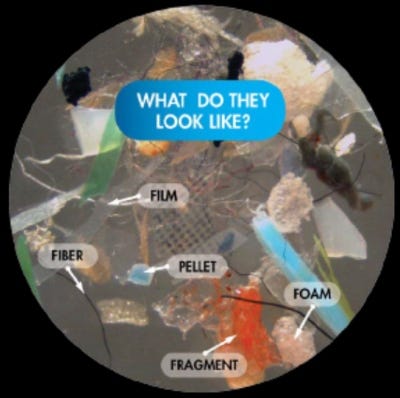
Common Types of Microplastics We Encounter
Plastic fragments
These are tiny pieces that break off larger plastic items over time. Water bottles, food containers, packaging, toys, and countless household products eventually degrade into smaller and smaller particles.
Microfibers
These are microscopic fibers shed from synthetic fabrics such as polyester, nylon, acrylic, and fleece. Every time we wash synthetic clothing, millions of tiny fibers can be released into wastewater and eventually the environment.
Tire wear particles
One of the largest and least recognized sources of microplastics comes from vehicle tires. As tires wear down on roads, tiny particles are released into the air, soil, and waterways. Researchers are paying increasing attention to this source because of its widespread environmental presence.
Microbeads
These are intentionally manufactured plastic particles once commonly found in personal care products such as exfoliating scrubs and toothpaste. Many countries have restricted their use, but they remain an important example of plastics designed to be microscopic from the start.
Food packaging particles
Plastic containers, plastic-lined wrappers, disposable cups, takeout containers, and food packaging can shed particles over time, especially when exposed to heat, friction, or repeated use.
Industrial pellets (”nurdles”)
These small plastic pellets are the raw material used to manufacture plastic products. When spilled during transport or manufacturing, they can enter waterways and break down into smaller particles over time.

Another Useful Distinction
Scientists also divide microplastics into two broad categories:
Primary microplastics are manufactured to be tiny from the beginning, such as microbeads or industrial pellets.
Secondary microplastics are created when larger plastic items break down through sunlight, heat, weather, friction, and age. Most of the microplastics people encounter today are thought to come from this second category.
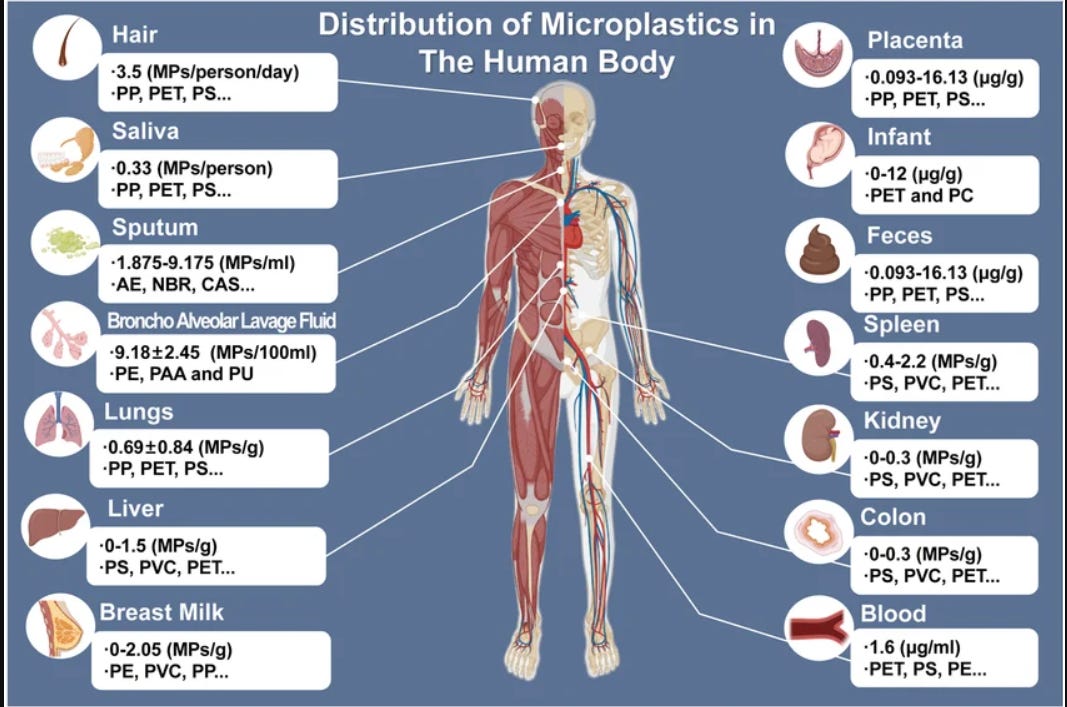
Researchers have found microplastics virtually everywhere they have looked: in oceans, rivers, soil, rainwater, and increasingly, in the human body itself.
Go back even fifteen or so years ago, if someone had told me scientists would eventually find plastic particles in human tissues, I probably would have assumed they were exaggerating. Yet study after study continues to detect microplastics in different parts of the body. Not in a few people. In nearly everyone.
The conversation is no longer about whether we are exposed. We most certainly are. So the conversation then shifts to what that exposure means.
One of the challenges in microplastic research is the lack of an obvious control group. How do you compare people exposed to microplastics with people who have never been exposed when virtually everyone alive today has encountered them? It would be like trying to study the effects of air while everyone on Earth is breathing it. Scientists are doing their best to untangle the puzzle, but many of the studies are observational. Researchers can identify associations and patterns, but proving direct cause and effect is much harder.
Still, I don’t think uncertainty means we should ignore the issue. In fact, uncertainty often invites curiosity. We don’t have to know everything to ask reasonable questions.
What struck me most as I started reading about microplastics was how passive much of our exposure appears to be. Nobody wakes up and decides to consume microplastics. We don’t sprinkle them on our breakfast cereal. We don’t order extra microplastics with our coffee. Yet somehow they find their way into our food, our water, the air we breathe, and the environments where we live.

Plastic Becomes Personal
I started looking around my own kitchen. Plastic food containers. Plastic wrap. Plastic packaging (almost always, except for fresh foods like fruits and veggies). Plastic-lined wrappers. Plastic bottles. Plastic storage bags. Even products that don’t seem to contain plastic often have some plastic component involved in their manufacture, packaging, transport, or storage. Once you start noticing it, you realize plastic isn’t just something we use. It has become part of the background scenery and foreground of modern life.
Eating out may be one of the clearest examples. Fast food and takeout often involve multiple layers of packaging. Drinks come in plastic cups with plastic lids and plastic straws. Food is wrapped in coated papers, packaged in containers, and carried home in plastic bags. Even butter and milk, the simplest foods imaginable, often arrive wrapped in plastic.
I also found multiple water bottles of different types in my pantry. Here’s a breakdown of the world of plastic water bottles.

Common Plastic Water Bottle Types
#1 PET (Polyethylene Terephthalate)
Most single-use water bottles.
Generally considered low in BPA because it does not contain BPA.
Can shed microplastics, especially with heat, sunlight, and repeated use.
#7 Polycarbonate (older reusable bottles)
Historically the biggest BPA concern.
Less common today, though some older bottles still exist.
BPA-Free Bottles
Often use alternative chemicals such as BPS or BPF.
Usually considered an improvement, but researchers continue studying long-term effects. There isn’t substantial proof that these are “safe.”
Do microplastics cause cancer?
Upon research, I found this snippet about this subject from the American Cancer Society:
At this time, there isn’t enough evidence to know if microplastics cause cancer, and if so, how. No agency has officially determined that microplastics pose health risks for humans.
Some research has found that microplastics can damage DNA, injure the lining of organs, cause inflammation, and disrupt gut health. Microplastics may also introduce bacteria, chemicals, and other toxins deeper into the body. These processes are known to promote cancer growth. One study showed that cancerous tumors have a higher level of microplastics than healthy surrounding tissue. Early research has also suggested possible links between microplastics and infertility, dementia, heart attacks, and strokes.
“Ultimately, we need more research and more data to learn how microplastics affect human health, including their role in cancer,” said Dr. Jayakrishnan.
What we can control, and what we can’t.
In psychology, there is a concept called the illusion of control. Sometimes we believe we have control over things we really don’t. But there is another problem we don’t talk about enough: assuming we have no control when we actually do. Microplastics may fall into that category. No, we cannot eliminate exposure entirely, and if you think you can, you’re sadly mistaken. But can you reduce exposure? That’s a different conversation, and the answer is, yes!
We can choose glass storage containers when it makes sense. We can avoid heating food in plastic. We can use stainless steel or glass water bottles. We can avoid drinking water from sun-exposed water bottles. We can choose cast iron or stainless steel cookware. We can store food differently. None of these decisions are dramatic or require a complete lifestyle overhaul, but simply shift the odds in our favor a little bit more.

What surprised me most was learning about tire dust. I had never really thought about it before. Every day, millions of vehicles travel roads around the world. Tires wear down. Tiny particles are released into the environment and become airborne. These can settle into soil and water, or our lungs. Road runners, cyclists, etc., beware.
Researchers are increasingly interested in understanding the extent to which these particles contribute to overall microplastic exposure. Whether future studies confirm larger or smaller effects than currently suspected, it serves as a reminder of how much happens around us that we rarely notice.
The Bigger Lesson
The bigger lesson here is that health isn’t only about the decisions we make consciously. Our health is also influenced by the environments we create and inhabit. Some of those influences are obvious, while others are nearly invisible. Obviously, microplastics fall into that second category because we can’t see or feel them. We don’t receive an alert on our phones every time a microplastic is in our vicinity (and while that might be cool for a while, we would shut that feature off in no time).
I don’t want to create fear, although some fear can lead to better decisions, but it can just as easily lead to poorer ones. I really just want to create awareness because awareness creates options. Once we know something exists, we can decide what to do with that information. We can ignore it, obsess over it, or take the middle path, which is usually where I find myself. We can acknowledge reality, make reasonable adjustments when possible, and continue living our lives knowing we are doing our part to be healthy.
Health has always been a game of probabilities, not guarantees. We wear seat belts because they improve our odds. We wash our hands because they improve the odds. We exercise because it improves the odds. Reducing unnecessary exposure to substances that may not belong in the human body strikes me as a similar decision.
Will avoiding a plastic container here and there change your life? Probably not, but then again, health rarely changes because of one decision. It changes because of hundreds of small decisions that accumulate over time.
Perhaps the real Health Shift is recognizing that awareness itself is a health behavior. Exposure is both active and passive. After we know where we’re likely in danger, we can choose what to do with that information. And while we may not be able to control every source of microplastics in the modern world, we can certainly become more thoughtful participants in it. I hope this article helps you do that!
See you next week, health heroes.
Dr. Alice

The Health Shift, by Strategic Action Health
Dr. Burron is the author of the book HealthShift: Your Personalized Guide to Making Strategic Health Decisions. Perhaps you or someone you know needs some guidance in making better health decisions? Let’s help people make better health decisions!
Dr. Burron is also a co-founder of Strategic Action Health, dedicated to helping organizations support their employees in making better health decisions. Come check us out here!
Catch us on Instagram: @the.health.navigator and @dr_burron
You can also connect on LinkedIn 👓
And if you’re not subscribed to Health Shift here on Substack, don’t you think it’s time?! This always-free newsletter is packed with valuable information and approaches to help you on your journey to better, faster healing.