
Are We Blaming the Wrong Things for Our Health Problems?
Correlation is a clue, not a conclusion.

Today I was thinking about data analysis and running correlations as we were doing some deeper analysis on a current project. It made me realize that all of us run correlations in our minds every single day. We are constantly connecting dots, looking for patterns, and trying to understand why something happened to our health. What a great topic!
Running individual correlations in our heads is a survival mechanism. It helps us to avoid bad things, turn to better ones, adapt, protect ourselves, and make decisions. But it can also work against us when we begin to assume that, because two things appear connected, one must have caused the other. I see many people connecting dots where dots don’t connect.
When something changes in our health, our brain naturally starts looking for a reason. We want the story to make sense. I ate this, and then I felt worse. I started that supplement, and then I felt better. I had a stressful week, and then my symptoms flared. We begin connecting dots and trying to solve our problem. We become mad scientists, looking for clues.

But absolutely, a pattern can be useful. If every time you skip sleep, your headaches worsen, that is worth noticing. If your blood pressure rises during stressful months, that deserves attention. If a certain food repeatedly seems connected to digestive symptoms, it may be a valuable clue. Correlations can help us pay attention, ask better questions, and decide what to explore next. But correlation is not always causation; we often want it to be, but to know if it is, we need to do some further investigating.

Everyone here in Wyoming is complaining about the bizarre weather and how the weatherman is not getting predictions right. We have no idea what to expect from one day to the next, but it’s never been as unpredictable as it is now; at least not in my lifetime.
The body is like a complicated weather system. Sleep, stress, food, hormones, movement, medications, inflammation, expectations, environment, genetics, and timing all affect the weather, and while we don’t know whether we’re going to get a rainstorm or a sunny day, we can try to predict it. And health is subjected to elements that we have never faced before. Processed foods, contaminants, environmental pollutants, plastics… Regardless, we try to make sense of it and predict it, like the weather. Sometimes we’re wrong. There is no perfect system to predict health. And sometimes we’re foolish enough to blame the umbrella for the thunderstorm.
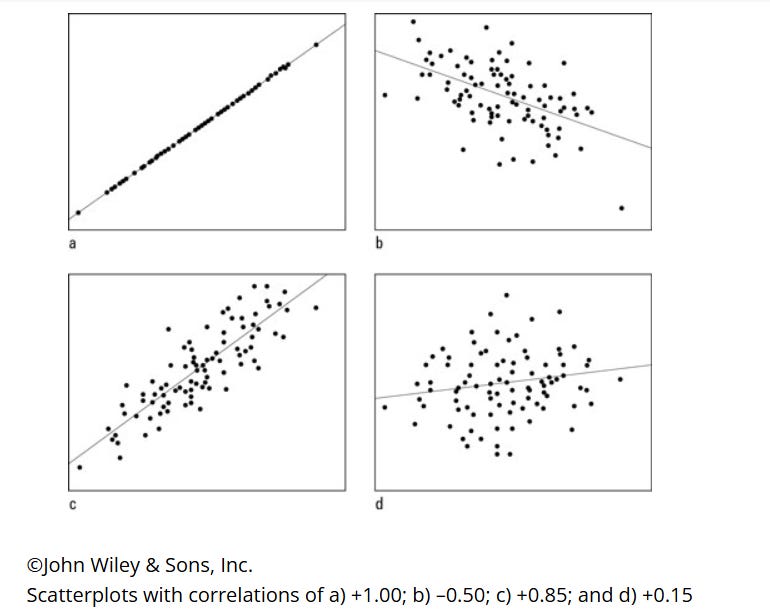
A scatterplot can best show how we try to make sense of the madness. If the plot shows two variables moving in the same direction, they are said to be positively correlated; if they move in opposite directions, they are said to be negatively correlated. Both show correlation. However, when variables are scattered, they are not correlated well. Correlation simply shows a possible association worth exploring. If two variables appear related, that does not prove one caused the other.
Let me give you a simple example of correlation not explaining causation.
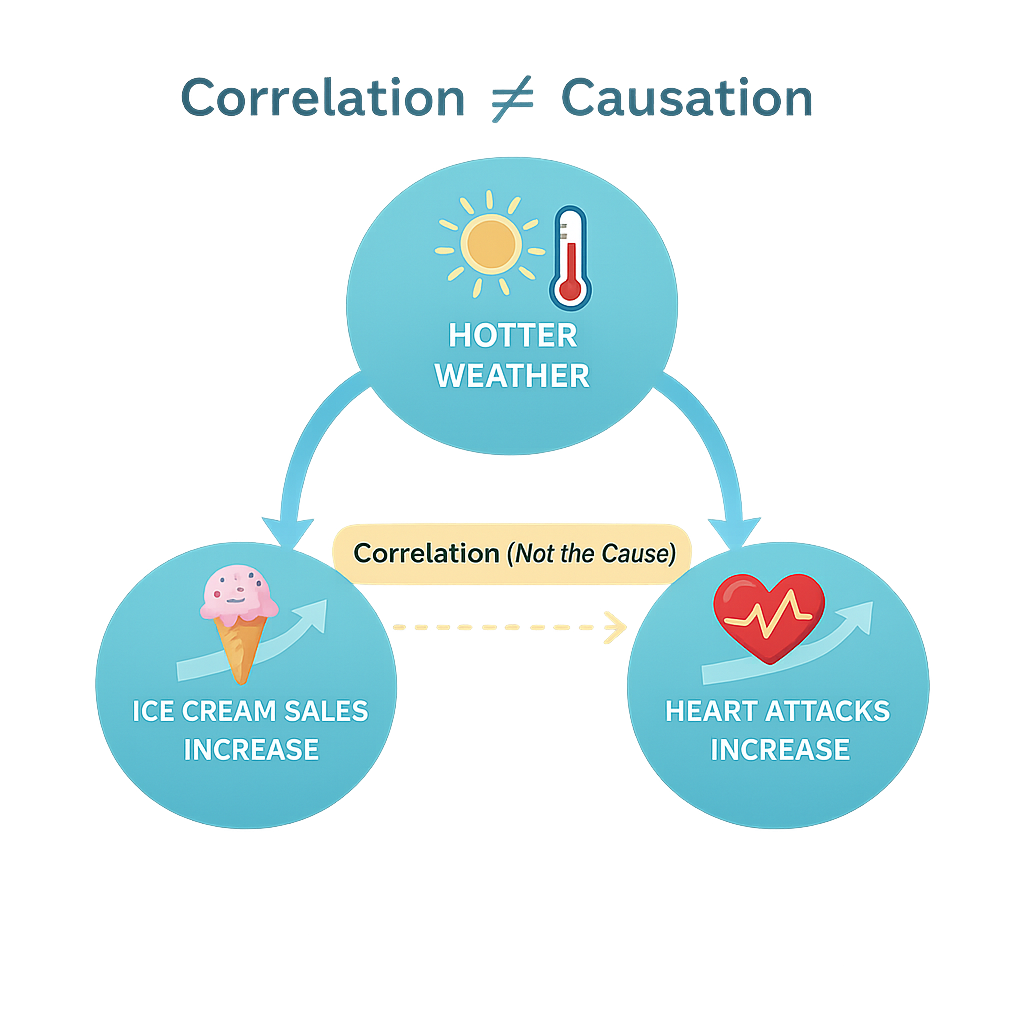
A study found that as ice cream sales increase in a community, heart attacks also increase there. At first glance, the data may suggest that when ice cream sales rise, heart attacks also increase. That can sound alarming, as if ice cream is somehow causing heart attacks.
…but the hidden variable is temperature.
People buy more ice cream during hot weather, and heart attacks also tend to rise during extreme heat because heat places additional stress on the body and cardiovascular system.
Ice cream and heart attacks are correlated, but ice cream itself is not necessarily the cause. Both are being influenced by a third factor: hotter weather.
So what can we do about this? First off, instead of saying, “This caused that,” we can pause and say, “This may be connected. Let me investigate.” This is a subtle, yet powerful, shift in approach. When you notice a possible health correlation, ask:
What else changed at the same time?
Has this happened more than once?
Could timing be fooling me?
Is there another explanation?
Am I emotionally attached to this conclusion?
What evidence supports this idea?
What evidence challenges it?
Could this be one factor, but not the only factor?
Is this pattern strong enough to act on, or does it need more observation?
What would I track for a few weeks to better understand it?
Do you see where asking questions and building curiosity become a life skill? You are respecting the potential correlation by examining it carefully.
A suspected correlation can become a useful theory. A theory can become something you test. Testing can help you make better decisions. But skipping straight from “I noticed this” to “I know this caused it” can lead to unnecessary fear, wasted money, abandoned treatments, extreme diets, supplement hopping, or blaming yourself for something far more complex.

Let me be clear, the goal is not to doubt everything. The goal is to hold your conclusions lightly until they earn more confidence.
A practical way to sort through a possible correlation is to track it. Write down what happened, when it happened, what else was going on, and whether the pattern repeats. Look for additional associations. Were you sleeping less? Eating differently? More stressed? Less active? Fighting a virus? Changing medications? Traveling? Dehydrated? Overdoing it? Under-recovering?
In health, the first explanation is not always the best explanation.
Keep in mind, sometimes X really does influence Y. Sometimes X is only one small piece of Y. Sometimes X and Y are both being influenced by Z. And sometimes, X and Y just happened to bump into each other in the hallway and now your brain is planning their wedding. :)
Correlations can help us notice patterns worth exploring. The danger comes when people assume a health certainty too quickly, ignore hidden or undiscovered variables affecting their health, generalize individual experiences to everyone else (or the opposite), and confuse timing with causation (such as assuming that because one thing happened before another, it must have caused it).
This is why strategic health thinking is so important! Remember this: The healthier question is not always, “What caused this?” but instead “What might be connected — and how can I find out?”
Until next time, Health Heroes!
Dr. Alice

The Health Shift, by Strategic Action Health
Dr. Burron is the author of the book HealthShift: Your Personalized Guide to Making Strategic Health Decisions. Perhaps you or someone you know needs some guidance in making better health decisions? Let’s help people make better health decisions!
Dr. Burron is also a co-founder of Strategic Action Health, dedicated to helping organizations support their employees in making better health decisions. Come check us out here!
Catch us on Instagram: @the.health.navigator and @dr_burron
You can also connect on LinkedIn 👓
And if you’re not subscribed to Health Shift here on Substack, don’t you think it’s time?! This always-free newsletter is packed with valuable information and approaches to help you on your journey to better, faster healing.